
The Redcoats
are Coming!: British Troop Movements
to North America in 1814
by Donald E. Graves
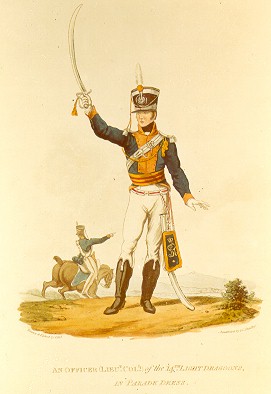
Officer of the 14th Light Dragoons in
Parade Dress by C.Hamilton Smith
Part of this unit serviced dismounted during the New Orleans campaign (
Parks Canada)
On 6 April 1814, as allied armies closed in on Paris, Napoleon Bonaparte, emperor of the French, abdicated his throne, bringing to an end almost two decades of ceaseless warfare in Europe. A few days later, Lord Bathurst, Colonial Secretary and the British cabinet minister primarily responsible for overseas military strategy, informed Lieutenant General Sir George Prevost, commander of the forces in North America, that he would shortly be receiving massive reinforcements. This was welcome news for Prevost who, for nearly two years, had been trying to defend Britain's Canadian colonies, conscious his was only a secondary theatre and that he could not expect major increases in his strength until the main objective -- the defeat of Napoleon -- had been accomplished. That had come to pass and, over the next eight months, the number of British regular troops in North America would more than double -- from 19,477 to 48,163 officers and men.
In some of the older American histories of the War of 1812, a myth frequently appears about these newcomers to the conflict in America. They are often described as picked troops from Wellington's Peninsular Army, the most successful military force in Europe in the spring of 1814, who crossed the Atlantic to chastise Cousin Jonathan for his perfidy, only to come to grief at Baltimore and New Orleans.
My purpose in writing this article is to lay this hoary old myth to rest be examining British trans-Atlantic troop reinforcements from April to December 1814 with a view to answering three questions:
1. What proportion of these reinforcement units were actually from the Peninsular Army?
2. If the 1814 reinforcement units were not from the Peninsular Army, what commands did they come from?
3. What proportion of these reinforcement units went to British North America (the colonies of Upper and Lower Canada, New Brunswick, Nova Scotia and Newfoundland) and what proportion went to American soil (the Chesapeake area and later, in some cases, Louisiana).
The 1814 Troop Reinforcements: An Overview of Origins and Destinations
The evidence reveals that, in the eight months from April to the official end of the war on 24 December 1814, Britain dispatched 1 cavalry regiment, 33 infantry battalions and 10 artillery companies (1 Royal Horse Artillery Troop or Company, 1 Royal Marine Artillery Company and 8 Royal Artillery Companies) to North America. One unit, the 2nd West India Regiment, which was dispatched to the Chesapeake area in early 1815, has not been counted in the figures below as it arrived in theatre after the peace treaty was signed.
Table 1 summarizes the command origins of these units and their destinations in North America. It demonstrates that just under half (21 of 44 units) were drawn from Wellington's command and, of these veteran troops, about two-thirds of the infantry units went to British North America and the remainder to American territory. Of the 23 units drawn from other commands, a larger proportion, 9 of 23 units, went to American soil. Overall, slightly more than 60% of the total troop reinforcement ended up in British North America, an indication of the priority given to that theatre in British strategic planning.
One seeming anomaly that does appear Table 1 is the high number of artillery units sent to American territory (5 of 10 companies). This can be explained by the fact that there was already a considerable artillery establishment in the British colonies large enough to warrant a major general's command and it was backed up at important garrisons by Canadian volunteer and militia gunners.
Table 1: Overview of Command Origins and Destinations
Note: The figures in brackets are for infantry and cavalry units only
| Destination | From Peninsula Army | From Other Commands | Totals |
| Canadas Maritime Provinces American Territory |
12
(9) 1 (1) 8 (6) |
10
(8) 4 (4) 9 (6) |
22
(17) 5 (5) 17 (12) |
| Totals | 21 (16) | 23 (18) | 44(34) |
The Units from the Peninsular Army
Table 2 lists the 21 units from Wellington's command sent across the Atlantic in 1814. In April of that year the Peninsular Army consisted of a cavalry division, a light infantry division, and seven divisions (numbered 1 to 7) of line infantry. The Cavalry Division contributed one unit while, with the exception of the 6th Division which contributed no reinforcements, all the infantry divisions (including the Light Division) sent two, and the 2nd and 4th Divisions each sent three units. No less than five veteran artillery companies were dispatched, with three of them going to British North America.
The reason the 6th Division did not contribute any units is because it had recently suffered heavy casualties (1,515 of a total strength of 5,600) at the battle of Toulouse fought on 10 April 1814 and its component units were weak in numbers. The 2nd and 4th Divisions probably contributed additional units because they were among the strongest formations in the Peninsular army.
Overall, there were 67 battalions of infantry under Wellington's command in April 1814, including the King's German Legion and two foreign corps. The Peninsular army therefore sent just under a quarter of its infantry to North America.
Table 2: Units from Wellington's Peninsular Army Sent to North America, 1814
| Unit Formation | Destination |
Cavalry 14th Light Dragoons Cavalry Division Infantry 1/3rd Foot 2nd Division 1/4th Foot 5th Division 1/5th Foot 3rd Division 1/6th Foot 7th Division 1/7th Foot 4th Division 1/9th Foot 5th Division 3/27th Foot 4th Division 1/39th Foot 2nd Division 1/40th Foot 4th Division 1/43rd Foot Light Division 57th Foot 2nd Division 76th Foot 1st Division 1/82nd Foot 7th Division 85th Foot 1st Division 1/88th Foot 3rd Division 3/95th Foot Light Division Artillery Carmichael's Coy, RA Peninsular Army Michell's Coy, RA Peninsular Army Turner's Coy, RA Peninsular Army Maxwell's Coy, RA Peninsular Army Trelawney's Coy, RA Peninsular Army |
Louisiana
The Canadas Chesapeake The Canadas The Canadas Louisiana The Canadas Maritime Provinces The Canadas Louisiana Louisiana The Canadas The Canadas The Canadas Chesapeake The Canadas Louisiana
Chesapeake Chesapeake The Canadas The Canadas The Canadas |
The Units from Other Commands
Table 3 lists the 23 reinforcement units derived from commands other than the Peninsular Army. Table 4 analyzes these units as to their command or point of origin.
It is often overlooked today but Wellington's army was not the only British field army during the latter years of the Napoleonic War and other active commands provided 6 reinforcement units. Lyndoch's command in northern German and Holland contributed 4/1st Foot and 2nd Rocket Troop to North America while four sound units -- 1/27th, 1/44th, 1/58th, and 1/81st Foot -- derived from Bentinck's "East Coast" army which carried out independent operations in Spain and northern Italy in 1813-1814.
It would be a mistake to describe the remaining 17 reinforcement units as green or garrison troops. Leaving alone the 5 Royal Artillery, Royal Marine and Royal Marine Artillery units, always well-trained and very professional soldiers, the 16th Foot was a veteran regiment recently sent home to recruit its losses while the 29th Foot from Gibraltar had long served with the Peninsular Army until casualties forced it from the field but it had recently been brought back to strength. The 1/21st and 1/62nd Foot had seen active service in the Mediterranean in 1813 when they had participated in the successful siege of Genoa, of which they formed part of the garrison when they departed for points west. Finally, the two West India Regiments had been long in service and had seen combat although not within the previous few years, but their enlisted men were known for their bravery and enthusiasm.
This leaves just 6 units originating from garrisons -- 1/37th, 7/60th, 1/90th, 1/93rd, and 2/93rd -- which might be regarded as not quite up to the quality of the other troops sent to North America. It is interesting, however, to note that 5 of these units were sent to the Canadas or the Maritimes and saw very little action while the one unit that went to American territory, the 1/93rd, performed very well at New Orleans.
Table 3: Units from Other Commands Sent to North America, 1814
| Unit | Previous Station | Destination |
Infantry 4/1st Foot 16th Foot 1/21st Foot 1/27th Foot* 29th Foot 1/37th Foot 1/44th Foot* 1/58th Foot* 7/60th Foot 1/62nd Foot 1/81st Foot* 1/90th Foot 1/93rd Foot 2/93rd Foot 97th Foot 1st West India Regiment 5th West India Regiment 2nd Battalion, Royal Marines Artillery 2 Troop, Rocket Brigade, RHA Pym's Coy, RA Maclachlan's Coy, RA Addams's Coy, RA Harris's Coy, RMA |
United Kingdom France Genoa, Italy United Kingdom Gibraltar United Kingdom Spain Spain United Kingdom Genoa, Italy Spain West Indies South Africa United Kingdom West Indies West Indies West Indies United Kingdom
Germany Genoa, Italy United Kingdom United Kingdom United Kingdom |
The Canadas The Canadas Chesapeake The Canadas Maritime Provinces The Canadas Chesapeake The Canadas Maritime Provinces Maritime Provinces The Canadas The Canadas Louisiana Maritime Provinces The Canadas Louisiana Louisiana Chesapeake
Louisiana Chesapeake The Canadas The Canadas Chesapeake |
Table 4: Point of Origin, Units from Other Commands
Field Armies and Commands:
German Army: 2
"East Coast" Army in Spain: 4
Garrisons
United Kingdom (including
Ireland): 8
West Indies: 4
Mediterranean: 3
Gibraltar: 1
South Africa: 1
Total: 23
British Troop Dispositions in North America in 1814 in Terms of Numbers
The British army was mustered and paid on the 25th day of every month and these monthly returns will be found in the War Office 17 Record Group of the Public Record Office. Although care must taken with the figures in these records as they will often vary from the more detailed and reliable regimental returns found in War Office 25, the monthly returns provide a fairly broad overview of the general dispositions of the army. Table 5, extracted from the return for 25 December 1814, the day after the Treaty of Ghent was signed, reveals that the dispositions of the army in North America were as follows:
Table 5: British Troop Dispositions, North America, 25 December 1814
| Location | Numbers of Officers and Men |
Upper and Lower Canada & the Old Northwest: Maritime Provinces (including Bermuda): American Territory
|
30,728 6,588
2,144 1,205 7,498 |
Total |
48,163 |
Note that these figures do not include the detachments of Royal Marines serving on warships. Every Royal Navy warship from a sloop carrying 14 or more guns up to a 1st Rate ship of the line (100 guns or more) carried a fixed number of marine varying from 1 officer and 27 enlisted men on a sloop to 3 officers and 108 enlisted men on a first rate. These shipboard marines were often combined to form ad hoc battalions for shore service.
Also note that, although these figures include 5 fencible regiments and the 104th Foot recruited in North America, they do not include Incorporated Militia Battalion of Upper Canada, and the Voltigeurs Canadiens and 6 battalions of Select Embodied Militia from Lower Canada which, despite their titles, were long service units almost on a par with regular troops. These units would add about another 4,000 men to the total above for the Canadas.
Table 6 summarizes the strength of the British army in North America on 25 December 1814 in terms of the number of units:
Table 6: Strength of the British Army in North America in Terms of Units, 25 December 1814
| Location | Infantry Battalions (or part) |
Artillery Companies (or part) |
Cavalry Regiments (or part) |
Canadas and Northwest Maritime Provinces American Territory |
40 13 25 |
15 8 8 |
1 - 1 |
| Totals | 78 | 31 | 2 |
(or part) (or part) (or part)
To the figure for the Canadas could be added the 8 battalions of Incorporated Militia, Voltigeurs Canadiens and Select Embodied Militia in service in December 1814.
Conclusions
Contrary to the old myth, less than half the troop reinforcements sent to North America in 1814 were drawn from Wellington's veterans. The Peninsular army contributed 21 units, including 16 infantry battalions of the 67 British or foreign battalions on its establishment in April 1814, less than a quarter and even less when it is remembered that the Peninsular army also possessed about 30 battalions of Portuguese infantry.
The remaining 23 units sent to North America were drawn from a variety of active and garrison commands but, with the possible exception of just 6 units, all were either well-trained professional or veteran units, many of whom had seen recent action with other British field forces.
The greater part of the 1814 reinforcement units (just over 60%) were sent to the British North America colonies, in keeping with British strategic policy that the first priority was the security of these colonies and the second the launching of a major offensive south from Canada. Operations in the Penobscot and Chesapeake were regarded as being subsidiary and diversionary although, as they began to take on a life of their own, the strategic emphasis began to swing gradually to the south. By the end of the war, however, about 75% of the British troops in North America were serving on Canadian, not American soil.
The British and United States Armies in December 1814: An Attempted Comparison by Strength and Units
Because it may be of interest to some readers (although I have doubts about the wisdom of doing so), Table 6 is my attempt to compare the two opposing armies in terms of their numbers and types of units, and numerical strength. In compiling this table, the following equations have been made, based on the author's knowledge and experience of the organization and strength of the opposing forces: 1 British or Canadian infantry battalion equals 1 American infantry or rifle regiment; 1 regiment of British cavalry equals 1 regiment of American cavalry; 1 battalion of American artillery equals 3 British artillery companies; and the US Regiment of Light Artillery has been taken as a strength of 6 British artillery companies. The Incorporated Militia Battalion of Upper Canada, the Voltigeurs Canadiens and the Select Embodied Militia of Lower Canada have been included to provide an additional 8 battalions and 4,000 men for the British army. Accurate and reliable information on the strength of the regular U.S. Army during the War of 1812 is often very hard to find. Although the authorized strength of the establishment was about 57,000 by December 1814, the best figures I have been able to discover for the actual strength are 38,186 in September 1814 and 33,424 in February 1815. I have taken the average of 35,800 as the estimated strength in December 1814.
Table 6: The American and British Armies,
December 1814
| British army | United States Army | |
| Strength Cavalry regiments Infantry Battalions Artillery companies |
52,163 2 84 31 |
est.35,800 1 45 42 |
To this, however, it should be added that during the War of 1812 the United States called out some 10,110 volunteers in federal service, 3,049 rangers and 458,463 militia (197,653 in 1814 alone) and there were also 5,000 men from the navy and marines available for land service, if required. Given these figures, it is small wonder that British strategic planning during the War of 1812 emphasized the defensive.
Sources
Archival: Public Record Office, Kew, Surrey: Colonial Office 42 and 43, Original Correspondence, North America, 1814; War Office 17, Returns of the Army
Published: Various issues of Halifax, Montreal and Quebec Gazettes listing arrival of troopships and units at those places, June to October, 1814; Army List, 1814 (London, 1814); Lewis Butler, Annals of the King's Rifle Corps, Vol. II (London, 1923); Charles Field, Britain's Sea Soldiers: A History of the Royal Marines, Vol I (London, 1924); Edward Fraser and L.G. Carr-Laughton, The Royal Marine Artillery, Vol. I (London, 1930); J.M. Hitsman, The Incredible War of 1812. A Military History. Updated by Donald E. Graves (Toronto, 1999), 291-296, Appendices 2 and 3; N.C.E. Kerrick, The Story of the Wiltshire Regiment (Duke of Edinburgh's) the 62nd and 99th Foot (1756-1959) ... (Aldershot, 1963); M.E.S. Laws, Battery Records of the Royal Artillery, 1716-1859 (London, 1952); Charles Oman, A History of the Peninsular War, Vol. 7 (London, 1930 and 1997), 529-562; Charles Oman, Wellington's Army (London, 1913, 1993), 343-373, Appendix II, Divisional and Brigade Organization and Changes, 1809-1814, by C.T. Atkinson; Charles Stewart, The Service of British Regiments in Canada and North America (Ottawa, 1964); Stuart Sutherland, His Majesty's Gentlemen: A Directory of British Regular Army Officers of the War of 1812 (Toronto, 2000); Emory Upton, The Military Policy of the United States, (Washington, 1904).
Copyright: Donald E. Graves, not to be reproduced without permission of the author 2001